

Projects of the Klassik Stiftung Weimar are funded by the European Regional Development Fund (ERDF) and the Free State of Thuringia, represented by the State Chancellery of Thuringia, Department of Culture and the Arts.
A Dutch woman promotes Germany as a cultural nation
Special exhibition “Sophie. Power. Literature” at the Goethe- und Schiller-Archiv | 8 April – 15 December 2024
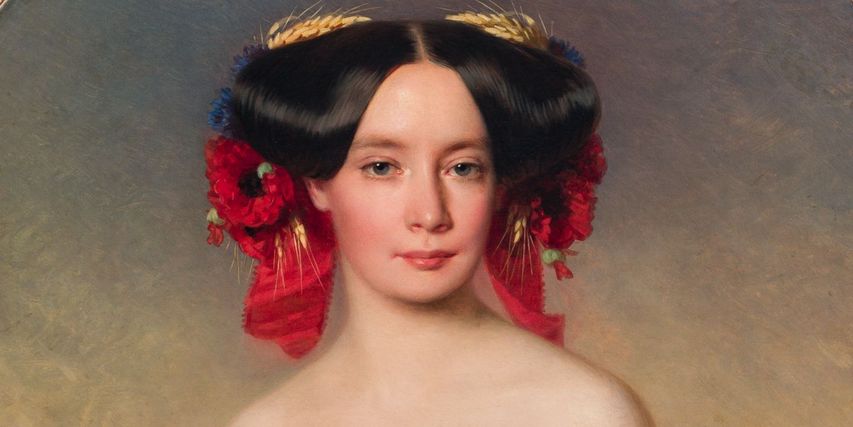
2024 marks the 200th anniversary of an extraordinary woman: Grand Duchess Sophie of Saxony-Weimar-Eisenach. Her achievements went far beyond the conventions of royal cultural patronage. With the initiation of the first complete edition of Goethe’s works, the Weimar Edition, and the founding of the first research-oriented literary archive on German soil, the native Dutch woman made an indelible impact on German cultural history and continues to influence the (inter)national image of Goethe today. The special exhibition “Sophie. Power. Literature – A Regent Inherits Goethe”, which will be shown at the Goethe- und Schiller-Archiv from 8 April to 15 December, takes a critical look at Sophie’s accomplishments and investigates the relationship between literature and power back then and in today’s cultural political environment.
“Sophie’s efforts to make Goethe’s literary estate accessible to researchers and the public played a key role in the UNESCO’s decision to add the poet’s manuscripts to the “Memory of the World” registry in 2001. Her personal and her financial commitment facilitated the construction of the Goethe- und Schiller-Archiv, which has since become a centre for our literary-cultural memory of the 18th and 19th century,” explained Dr Christian Hain, interim director of the archive.
In April 1885, the 61-year-old Grand Duchess was named the sole heiress of Goethe’s literary estate. Only five days after the testament was unsealed, Sophie had the valuable manuscripts transferred to the Weimar City Castle. By early May, the regent’s cultural-political ambitions were already laid down in a master plan: In addition to building a Goethe Archive, she aimed to produce the first complete edition of Goethe’s works and publish a comprehensive Goethe biography.
Influenced by the spirit of the Wilhelmine era which equated national identity with a national literature, Sophie recognised Goethe’s potential as a figure of identification for the Germans. In the same way Berlin was the nation’s political capital, Sophie hoped to establish Weimar as the centre of intellectual life in Germany. To achieve her goal, the Grand Duchess occasionally intervened in the research efforts. For example, Herman Grimm was forced to rewrite the preface to the Weimar Edition several times at her behest, and she censored the publication of certain erotic passages in Goethe’s “Venetian Epigrams” and “Roman Elegies”. Scholars, who were not involved in the Weimar Edition, were forbidden access to Goethe’s manuscripts so as not to endanger the exclusivity of the patriotic project.
The exhibition critically illustrates how Sophie shaped and continues to influence Goethe’s national and international image and explores the mutual relationship of literature and political power that existed in Sophie’s time and in our current cultural political moment.
The exhibition “Sophie. Power. Literature” illustrates how a Dutch woman single-handedly initiated and largely financed two of Germany’s most renowned projects of literary promotion. And once again, it underscores the role that archives play, along with the estates they preserve, as the keepers and official chroniclers of our collective memory.
The exhibition opens on 7 April at 11:30 am at the Goethe- und Schiller-Archiv.
Exhibition info:
Sophie. Power. Literature – A Regent Inherits Goethe
8 April – 15 December 2024
Goethe- und Schiller-Archiv | Jenaer Straße 1 | 99425 Weimar
Mon – Fri | 9 am – 6 pm, Sat, Sun | 11 am – 4 pm
Free admission
The anthology “Sophie. Power. Culture”, slated for publication in October 2024, will shed light on various aspects of the Grand Duchess’s life and manifold achievements for the first time.