
Projects of the Klassik Stiftung Weimar are funded by the European Regional Development Fund (ERDF) and the Free State of Thuringia, represented by the State Chancellery of Thuringia, Department of Culture and the Arts.
“Kunst am Bau”
in the Weimar City Palace
Single-phase, non-public design competition with preliminary expression-of-interest (EOI) procedure.
Jury session on 25 March 2025
Implementation of the winning concept: December 2025 – April 2026
Location: ground floor entrance hall in the east wing of the Weimar City Castle
Prizewinners
1st prize: Andrea Knobloch, Düsseldorf – “Im Sturm” (In the Storm)
2nd prize: The Green Eyl GmbH, Berlin – “Lichtbögen” (Arc of Light)
3rd prize: Via Lewandowsky, Berlin – “Nach Dienstschluss” (After Closing Time)
Design idea
In the Storm
Proposal for the Kunst am Bau competition “Weimar Castle Entrance Hall”
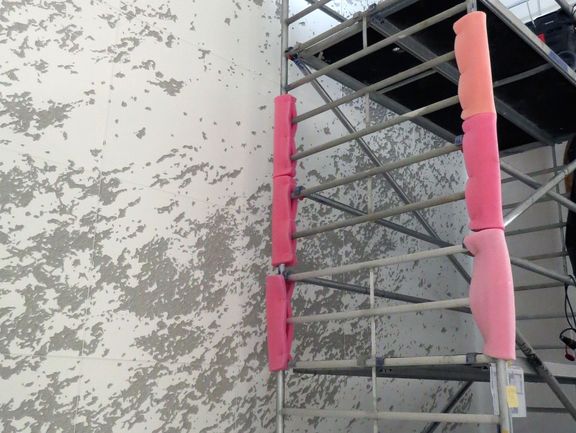
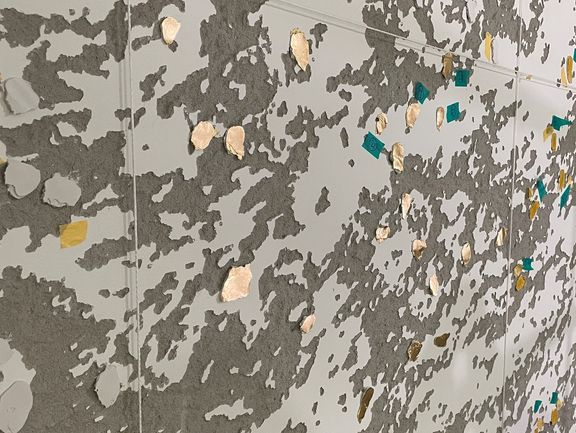
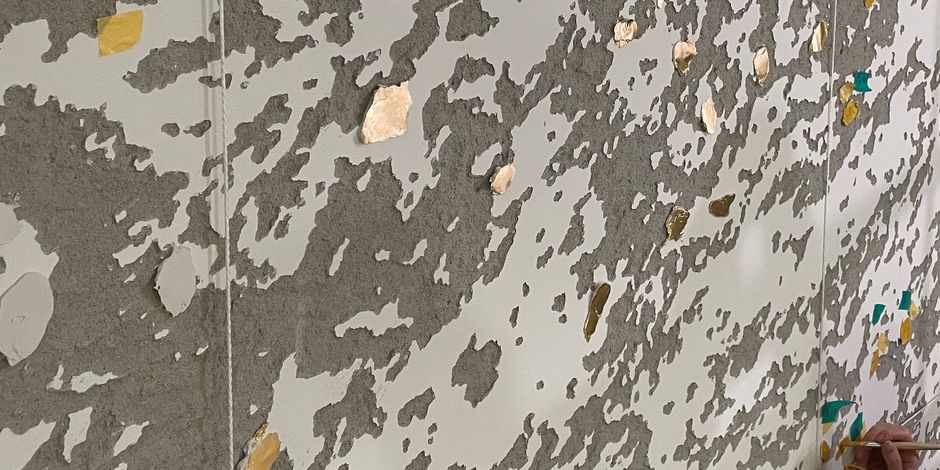
Upon entering the main hall, visitors are pulled inside by a furious gust of wind that emerges from the basement level and rises to the ceiling above a newly installed dividing wall on the right. A closer look reveals countless chips and dints in the bright white paint, exposing the grey plaster foundation beneath it. As if a vast swarm of particles tried to penetrate the wall with unbridled force. How does one explain these mysterious marks? Who has scattered the gold sparks across the wall, glittering with light? Could this be the motes of dust, whirled free by the wings of a gigantic angel that has suddenly come up against an unexpected barrier?
Background
Weimar’s residence castle has been visited by four firestorms over the course of its history. With each inferno, the works were replaced and the rooms rebuilt, modified to meet the latest functional and aesthetic requirements. Today the building comprises a collection of fragments from different epochs. The catastrophe of revenant fires was also the motor of modernisation. Destruction always creates space for something new – an ambivalent truth that is hard to accept, especially in view of shattered certainties.
Shaken by the outbreak of World War II, Walter Benjamin dedicated his “9th Historical Thesis” to the “Angel of History”. He describes an angel hovering motionless with outstretched wings and wide-opened eyes, “his face is turned toward the past. Where we see a chain of events, he sees one single catastrophe that keeps piling wreckage upon wreckage and hurls it at his feet. He would like to stay (...) and make whole what has been smashed. But a storm is blowing from Paradise ...,” irresistibly propelling him into the future, to which his back is turned. Benjamin concludes with the words: “It is this storm that we call progress.”
Benjamin’s conceptual image of the “Angel of History” was based on his intensive study of Paul Klee’s drawing “Angelus Novus”, which Benjamin had purchased years earlier in 1921 from the artist and future Bauhaus instructor. The new angel – just one of many divine entities that appear in the Jewish Kabbala that suddenly arise and then disappear like a “spark on the coals” after a few praising chants – is transformed in Benjamin’s rendering into a powerless angel who fails in his attempt to reconstitute the ever accumulating shards of history into something new and whole.
Constant change marches forever onward. Once again, Weimar’s City Castle is undergoing another renovation, yet remains both an impressive historical artefact and the result of constructive and destructive forces capable of sparking a “storm of progress”. The so-called “Gestapo cellar” in the basement serves as a reminder of irreversible deeds that can never be redeemed or made whole again. The Gentzian [RB1] staircase, on the other hand, arguably represents the highest cultural accomplishments that humanity is capable of when challenged to achieve its best and most beautiful.
“In the Storm” uses Benjamin’s interpretation of “Angelus Novus” as the starting point for examining the fragmented castle complex that has formed over the centuries. The perceived “presence” of historical events is aptly captured by the charred remains embedded in the masonry on the Beletage. This is symbolised by the chipped surface of the freshly painted wall – a reference to the ambivalence that underlies every human action – that the creation of the most beautiful things is always preceded by destruction. The concept “In the Storm” adds a productive agitation to the necessary renovation and reorganisation of the reception area. Although swept up in wild movement, it remains firmly anchored between the past and the future – like the storm-wrecked wings of the “Angelus Novus”.
Execution
The wall, for which the artwork is intended, will be covered by a 30mm-thick layer of grey plaster. This layer will serve as both the foundation and an integral component of the artwork. The plaster layer will be painted over in pure white. To ensure that visitors experience the entrance hall as a single, coherent room, all wall surfaces will be painted in the same colour.
The sculpting phase will begin after the wall is painted. Using 1:1 stencils, the artist will first trace the design onto the surface and then chisel out the indentations with small, chipping hammers. The grooves and indentations will range between 1mm and 15mm in depth. In an additional step, the exposed holes in the plaster will be sealed with a primer. The “sparks” will then be sculpted onto the wall and covered in goldleaf.
The plaster relief will react with the interior lighting, casting the indentations in delicate shadow and producing changing reflections across the gilded surfaces.
Excerpt from the jury assessment
The artistic design idea poetically highlights the specificity of this central historic location in the Weimar cosmos. It convincingly intertwines the constant destruction, layering and reshaping of this venue with one of the most influential historical-philosophical texts of the 20th century, Walter Benjamin’s “9th Historical Thesis”, as well as the inspiring work “Angelus Novus” by the Weimar Bauhaus master Paul Klee. In this way, the abstract work exudes an explicitly non-illustrative, site-specific referentiality, containing the full ambivalence of destruction and new creation. The intellectual stringency of this concept reflects the conceptuality of both Weimar Classicism and Bauhaus modernism, thus capturing a quality that is unique to Weimar.
This room-spanning, large-format artwork incorporates and encompasses the entire surface of the wall, exerting an almost overwhelming aura and immersive impact on visitors entering the Castle. It interconnects all the levels of the entrance hall in the most impressive manner. The work draws its aesthetic richness from the subtle dialectics of sculptural gesture and intensive materiality, as well as its impressively expansive agitation in a white, grey and gold colour spectrum, which translates the title of the piece into an almost physical experience. In this way, the storm of history is intuitively conveyed.