

Projects of the Klassik Stiftung Weimar are funded by the European Regional Development Fund (ERDF) and the Free State of Thuringia, represented by the State Chancellery of Thuringia, Department of Culture and the Arts.
History
„Country air, unspoilt nature, much grass and beautiful trees, outer peace and free disposition over myself and my time […] in my house in Ossmannstedt I feel incessantly content and happy.“
Wieland to his publisher Georg Joachim Göschen, 1797
The estate in Ossmannstedt is closely connected to Christoph Martin Wieland (1733-1813) who lived here from 1797 to 1803 and was later buried in the estate park in accordance with his wishes. He was one of the most successful writers of the 18th century and is credited for lasting achievements as a poet, translator, publisher and journalist. During his time in Ossmannstedt, he translated ancient manuscripts, wrote novellas and novels, published magazines and received numerous guests, including Goethe, the Herder couple, Duchess Anna Amalia, his childhood sweetheart Sophie von La Roche, Sophie and Clemens Brentano, Jean Paul and Heinrich von Kleist. Some of his visitors even wrote works in Ossmannstedt in Wieland’s company.
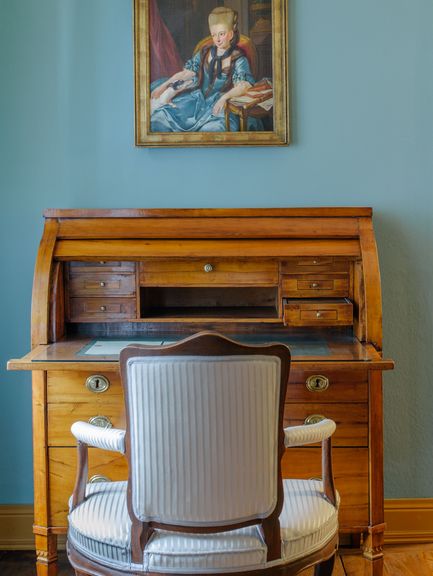
![[Translate to English:] Porträt Wielands im ersten Museumszimmer](/assets/media/d/0/csm_weimar_wielandgut_ossmannstedt_musikzimmer_klavier_98857c54b1.jpg "Wieland Estate in Ossmannstedt")
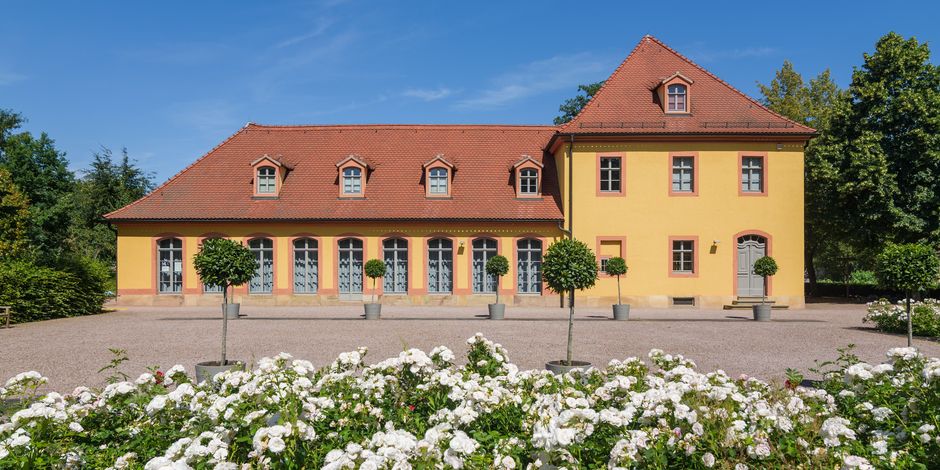
The two-story Baroque manor was built by the Weimar minister Count Heinrich von Bünau in 1757. From 1762 to 1775 Duchess Anna Amalia and her sons used the estate as a summer residence. After the ducal family had lost interest in Ossmannstedt, they leased the estate to a tenant in 1777.
In 1797 Wieland purchased the estate, its buildings and surrounding park. There he spent six years with his family enjoying a carefree life in the country. After his wife passed away, he moved back to Weimar in 1803. In 1813 he was buried next to his wife in the Ossmannstedt estate park.
Privy Counsellor John Grant of Glen Morrison and his family owned the estate between 1859 and 1896. They too were honoured by numerous guests, including Grand Duke Carl Alexander, Walther von Goethe, Franz Liszt and relatives of the Herder and Wieland families.
At the end of the 1940s, the estate was divided into parcels in accordance with the East German agrarian reform measure. The enclosure wall was torn down and the estate house was converted into a school. In 1953 ownership of the property was transferred to the National Research and Memorial Sites of Classic German Literature in Weimar (NFG), the predecessor institution of the Klassik Stiftung Weimar. The estate underwent thorough and extensive restoration measures from 1968 to 1974 and again from 2003 to 2005.