


Projects of the Klassik Stiftung Weimar are funded by the European Regional Development Fund (ERDF) and the Free State of Thuringia, represented by the State Chancellery of Thuringia, Department of Culture and the Arts.
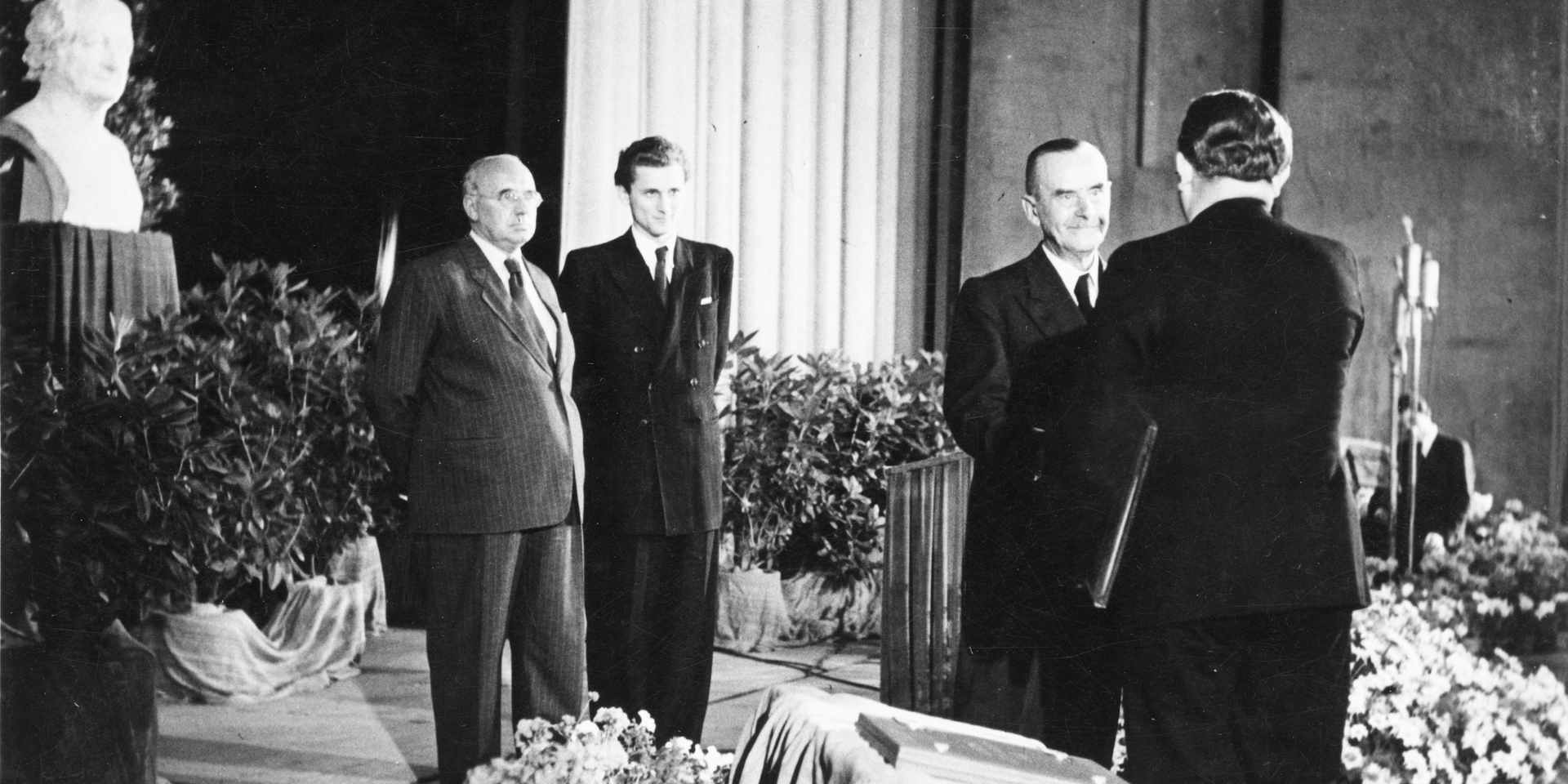
„Nun bin ich da ...“
World traveller Thomas Mann 1949 in Weimar

presentation
In 1949, Nobel Prize winner Thomas Mann, who had emigrated to the USA, travelled back to Germany for the first time. In the politically torn country, Weimar and Frankfurt am Main honoured him with awards. He received not only praise, but also criticism.
On 1 August 1949, the 74-year-old Thomas Mann received honorary citizenship of Weimar and the Goethe National Prize at a ceremony in the German National Theatre. This was created especially for him. The occasion: Goethe's 200th birthday. Mann expressed his gratitude for the honour with a programmatic speech, which he had previously delivered verbatim in Frankfurt: his visit was not for a Germany divided into occupation zones, but for the country as a whole. For him, the German language was a unifying medium.
Greeted with joy by the residents of Weimar, criticised by the West German press and others, himself wavering between sympathy and cautious distance, Thomas Mann spent eventful days in the city.
The studio presentation in a special room of the Goethe National Museum's permanent exhibition "Floods of Life - Storm of Deeds" tells the story of what he experienced in Weimar at the time. The centrepiece of the small show is the original manuscript of Mann's memorable speech.
Your visit
Opening hours
Address
Tickets
Free entry
plus museum admission
Accessibility
 Services for the hearing impaired
 Offers for the visually impaired
 Offers in the Weimar+ app
 Offers in DGS
 Offers in simple language
 Disabled toilet available
 Accessibility tested
 Elevator available
- Guided tours for blind and visually impaired groups of visitors possible
 Rollator access possible
 Wheelchair access possible
Accepted cards
- MuseumCard
- weimar card